
A successful refresh gives Currency DJ Frankfurter’s latest available reference-rate record; it is not a streaming real-time quote. Stored same-day data is shown as fresh, data 1–13 calendar days old as cached, and data 14 or more days old as stale. During session warmup, a covering snapshot less than 12 hours old can be reused without another fetch.
Latest available is not real-time
When Currency DJ refreshes, it asks its provider for the latest available rate records for the requested codes. The provider’s publication cadence and record date determine what comes back. The app does not stream a tradable market price and cannot guarantee an intraday update.
Use “latest available reference rate” as the accurate description. A recent fetch can still differ from a bank, card, ATM, checkout, or exchange-counter quote because those services use their own sources and commercial terms.
Fresh, cached, and stale use calendar age
A stored snapshot from the same calendar day is treated as fresh. From 1 through 13 calendar days old it is cached. At 14 days or older it is stale.
Stale is a warning, not an automatic lockout. Currency DJ can keep using a stale snapshot because no hard expiration removes it. The older the record, the less confidently it should anchor a current decision.
The 12-hour warmup rule answers another question
On initial converter use, Currency DJ can warm the needed rates. Within an app session, a base is warmed once. If a stored snapshot covers the needed currencies and is less than 12 hours old, the app can skip another network fetch.
That optimization does not redefine the status labels. Twelve hours controls whether warmup needs another request; same-day, 1–13 days, and 14-plus days control the visible freshness category.
Manual refresh has plan and network limits
Free allows one manual refresh attempt per 86,400 seconds. Because the attempt is recorded before the request finishes, a provider or network failure still uses it. Pro allows another attempt after a 30-second cooldown.
A successful request can still omit a selected code if the provider lacks a usable record. The app’s 160 selectable currencies describe the local picker, not guaranteed current network coverage.
How to use Currency DJ
- Read the status before deciding how much confidence to place in the displayed estimate.
- If the value is cached or stale and the decision matters, connect to a reliable network and use manual refresh when eligible.
- Wait for the request to finish and confirm that the status or provider date has actually changed.
- If no new record arrives, keep the old value only as a clearly labeled fallback.
- Compare the estimate with the transactional provider’s actual total and fees before paying or transferring money.
Limits to keep in view
- Currency DJ results are estimates based on the latest available or a cached reference rate. They are not bank, card, ATM, checkout, exchange-counter, or tradable forex quotes.
- Latest available describes the provider record returned, not continuous, guaranteed intraday, or executable market data.
- The stale threshold is 14 calendar days, and stale snapshots do not hard-expire.
- Automatic warmup, visible cache status, and manual refresh allowance use different clocks and should not be conflated.
- A failed manual refresh consumes the current Free attempt or begins the Pro cooldown.
Troubleshooting
The app opens without making a new request.
A covering snapshot less than 12 hours old can satisfy session warmup. Use manual refresh if eligible and you need to request the latest available record now.
Refresh finishes but the provider date does not change.
The provider may not have a newer record. Latest available does not guarantee that a new record exists at the moment you request it.
A stale result still converts normally.
That is expected because stale snapshots do not hard-expire. Treat the label as a caution and refresh before consequential use.
The refresh button cannot be used again after an error.
The allowance is consumed when the attempt begins. Free waits 86,400 seconds, while Pro waits through its 30-second cooldown.
Frequently asked questions
Does latest mean real-time in Currency DJ?
No. It means the latest available record returned by the reference-rate provider when the request succeeds, not a streaming or executable quote.
When does a Currency DJ rate become stale?
At 14 calendar days old. Data 1–13 days old is cached, and same-day stored data is shown as fresh.
Why are both 12 hours and 14 days mentioned?
They govern different behavior. Less than 12 hours can suppress another session warmup fetch; 14 days is the threshold for the stale status.
Does a stale snapshot expire?
No. It can remain usable as an estimate, which is why you must inspect the status and refresh whenever the age is inappropriate for the decision.
Sources and further reading
- Frankfurter exchange-rate API — Documentation for the reference-rate provider used by Currency DJ.
- Currency DJ: FX Converter on the App Store — Apple’s current product listing for Currency DJ.
Make the next conversion tactile
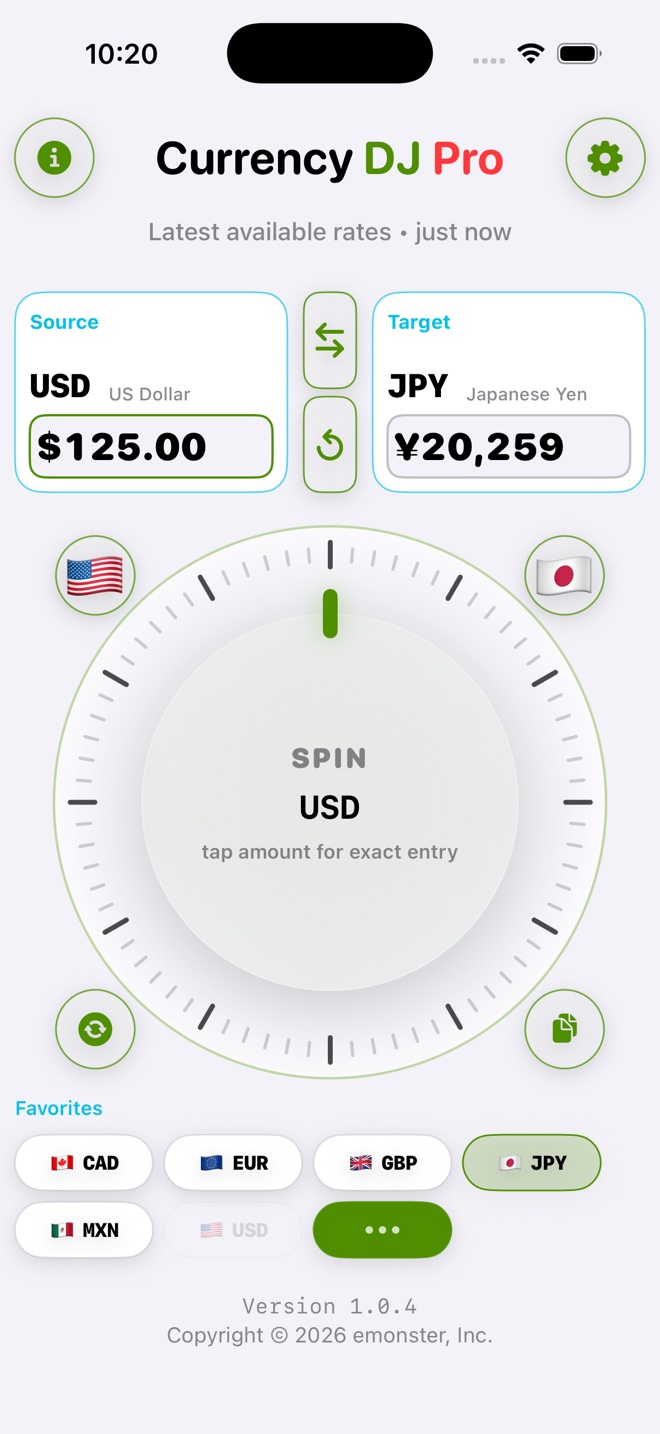
See rate freshness beside the conversion and keep “latest available” distinct from a transactional real-time quote.
Get Currency DJ on the App Store